
Working on a vintage bike recently I wanted to rebuild this as close as possible to the original version, with one exception, the wheelset.
The bike came with 27" wheels with high quality Araya alloy rims and Sunshine hubs. Very good but the rim edges where the tire meets the rim are straight with no lip to hold a modern clincher tire bead. Most 27" tires only allow 90 psi max. I had mounted Panaracer Pasela 27" tires on these rims and they worked well. The rear wheel had a flat spot, but not noticable except on fast descents. The straight edge rim of 27s left me wanting me to be able to run a tire at 95-100psi that with these rims might be a problem. I rode this pair of 27" wheels with the Paselas over Ebbetts Pass in the Sierras and on a few others rides without a hitch. But to my shock I saw the 27" rims had no lip after fixing a flat. For tires, you really don't want to mess around, so this was the main reason for switching to a modern 700c wheelset As a replacement, I had built-up a new wheelset with some NOS Maxi CAR high flange hubs and of Mavic Open Sport rims. These are fantastic riding wheels.
The 700c (622mm) wheel diameter is shorter than 27" (630mm) but easily adaptable to most bikes that originally came with 27" wheels. I've upgraded a few bikes with 27" wheels to 700c that allow much more of a range in tire widths and tire types.
Plus you can use tubes with lightweight presta valves that are better suited for road bikes than schrader style valves commonly found on 27" and MTB wheels. © 2011 VeloTouriste.
Sunday, April 3, 2011
Sunday, February 27, 2011
Rebuilding a "bike-boom" era Peugeot
After working on bikes over time, you may encounter recurring situations requiring an inordinate amount of patience.
French bikes always present their challenges, mainly with their obsolete threading. Most recently, it's been on rebuilding a 70s bike-boom era Peugeot UO-8 sport/touring bike. Although Peugeot has made great bicycles such as the renowned PX-10 racing bike, the UO-8 was one of the lower-end models, typical of the large volume of Peugeots sold in the US in the 70s for the mass market. I brought it home and considered how it could be best rebuilt. It made sense to make it a single speed, as the older, heavier steel frame would be well suited to a stripped down utility bike.
French bikes have unique threads that are difficult to deal with when you want to replace bearings. The steel cottered crankset and bottom bracket were pretty much obsolete. Once I actually was able to remove one side of the crank (extracting the pin that holds the crank arm) I found that trying to replace this with a square taper bottom bracket spindle wasn't going to work because the cottered bb spindle has different dimensions.
So I retrofitted it with aftermarket French thread bb cups and a modern sealed IRD bb. It turns out I managed to somehow cross thread one of the bb cups—no matter how much I tried, this just wasn't going to work.
Next stop: machine shop. I had the bottom bracket shell reamed and re-tapped.
Since spray can paint isn't very durable not being heat cured, I took the frame to a powder coater and had them redo the frame in a dark metallic blue. They did an excellent job and applied a clear coat that gives the normally dull powder coat finish a high luster.

I built the frame up as a single speed with a track wheelset. I chose to keep the original centerpull MAFAC Racer brakeset that has it's own history. Based near Auvergne region of France, MAFAC is an acronym for Manufacture Auvernoise de Freins et Accessoires pour Cycles.
More races have probably been won using on MAFAC Racer model brakes than any other brakes ever made. They present a mechanical challenge to adjust. The pads need to be exactly perpendicular to the rim when they come in contact and doing this is a feat by itself. Getting the right amount of gap between the rim and the pads is also somewhat of an art—enough gap so they don't rub, but tight enough so the brakes have enough grab, that has to do with the length of the brake straddle wire and where the center cable yoke is positioned...
The old black pads these came with have long since dried out and end up squealing and leaving deposits on rims. I replaced these with Kool-stop salmon pads. Also, the bushings for the bolts that hold the arms can wear over time and the slop can contribute to break squeal. If the brake assembly isn't lubricated this can rust and bolts can break. Although I lubed everything before reassembling and readjusting the brakes on this bike, I still managed to snap one of the brake arm mounting bolts and a center yoke bolt. Fortunately I had an extra set and I'll drill-out the broken bolt on the old pair sometime with a drill press. Once you get these brakes dialed in though they work well.

A general rule of thumb with all older brakes sets: you must lube all of the parts because these will surely break when you try to retighten things if they get corroded.
Once I retrofitted the Peugeot with new wheels, a new single speed drivetrain and new brake levers, I was having a really hard time with getting the rear brake to not squeal. I tried to "toe-in" the brakes and tighten the brake arms (why I broke one) to no avail. Eventually I reverted to a tip a mechanic gave me who's worked on cyclocross bikes "Sometimes all you can do is toe 'em in backwards".

After assembling the bike, I relettered the Peugeot logotype script from a vintage 50s catalog and had decals made. This old Peugeot is now transformed to a new life as a single speed and looks and rides fantastic.
The bike was too large for me and I ended up selling to a buyer in San Francisco. So if you see this bike around SF, you'll know this was rebuilt by someone who appreciates French bikes no matter what grade.
French bikes always present their challenges, mainly with their obsolete threading. Most recently, it's been on rebuilding a 70s bike-boom era Peugeot UO-8 sport/touring bike. Although Peugeot has made great bicycles such as the renowned PX-10 racing bike, the UO-8 was one of the lower-end models, typical of the large volume of Peugeots sold in the US in the 70s for the mass market. I brought it home and considered how it could be best rebuilt. It made sense to make it a single speed, as the older, heavier steel frame would be well suited to a stripped down utility bike.
French bikes have unique threads that are difficult to deal with when you want to replace bearings. The steel cottered crankset and bottom bracket were pretty much obsolete. Once I actually was able to remove one side of the crank (extracting the pin that holds the crank arm) I found that trying to replace this with a square taper bottom bracket spindle wasn't going to work because the cottered bb spindle has different dimensions.
So I retrofitted it with aftermarket French thread bb cups and a modern sealed IRD bb. It turns out I managed to somehow cross thread one of the bb cups—no matter how much I tried, this just wasn't going to work.
Next stop: machine shop. I had the bottom bracket shell reamed and re-tapped.
Since spray can paint isn't very durable not being heat cured, I took the frame to a powder coater and had them redo the frame in a dark metallic blue. They did an excellent job and applied a clear coat that gives the normally dull powder coat finish a high luster.
I built the frame up as a single speed with a track wheelset. I chose to keep the original centerpull MAFAC Racer brakeset that has it's own history. Based near Auvergne region of France, MAFAC is an acronym for Manufacture Auvernoise de Freins et Accessoires pour Cycles.
More races have probably been won using on MAFAC Racer model brakes than any other brakes ever made. They present a mechanical challenge to adjust. The pads need to be exactly perpendicular to the rim when they come in contact and doing this is a feat by itself. Getting the right amount of gap between the rim and the pads is also somewhat of an art—enough gap so they don't rub, but tight enough so the brakes have enough grab, that has to do with the length of the brake straddle wire and where the center cable yoke is positioned...
The old black pads these came with have long since dried out and end up squealing and leaving deposits on rims. I replaced these with Kool-stop salmon pads. Also, the bushings for the bolts that hold the arms can wear over time and the slop can contribute to break squeal. If the brake assembly isn't lubricated this can rust and bolts can break. Although I lubed everything before reassembling and readjusting the brakes on this bike, I still managed to snap one of the brake arm mounting bolts and a center yoke bolt. Fortunately I had an extra set and I'll drill-out the broken bolt on the old pair sometime with a drill press. Once you get these brakes dialed in though they work well.
A general rule of thumb with all older brakes sets: you must lube all of the parts because these will surely break when you try to retighten things if they get corroded.
Once I retrofitted the Peugeot with new wheels, a new single speed drivetrain and new brake levers, I was having a really hard time with getting the rear brake to not squeal. I tried to "toe-in" the brakes and tighten the brake arms (why I broke one) to no avail. Eventually I reverted to a tip a mechanic gave me who's worked on cyclocross bikes "Sometimes all you can do is toe 'em in backwards".
After assembling the bike, I relettered the Peugeot logotype script from a vintage 50s catalog and had decals made. This old Peugeot is now transformed to a new life as a single speed and looks and rides fantastic.
The bike was too large for me and I ended up selling to a buyer in San Francisco. So if you see this bike around SF, you'll know this was rebuilt by someone who appreciates French bikes no matter what grade.


Sunday, February 20, 2011
Replicant retro bike encounters
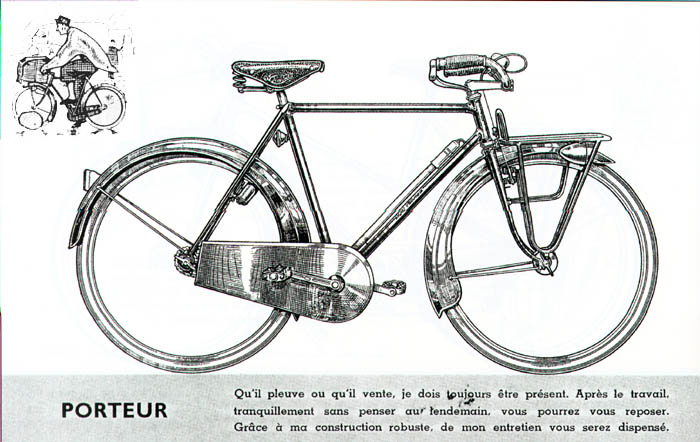
Riding back from work on my weekday commute recently on Caltrain, there was a woman in the bike car with a fairly opulent "mixte" bike (in the US, known as a women's bike with a lowered top tube and easier to step-over frame). It was made by Velo Orange, built-up in the classic French porteur style. It was equipped with the full array of VO branded parts, porteur handlebars, Peugeot style patterned fenders and racks with a wide platform porteur style rack up front.
In France porteur bikes were used by newspaper couriers often carrying very heavy stacks of newspapers, distributing them around the city. The VO bike had the porteur style rack and handlebars on these bikes, in a simple inverted U shape. It was medium blue with brightly contrasting orange cable guides. Not the usual commuter bike seen on CalTrain—as bikes can get beat up by other sometimes careless bicycle commuters.
I spoke with the owner of the VO mixte and she mentioned her boyfriend bought it for her at a local shop. She commuted from SF via CalTrain to San Jose had had a few different problems with this bike and really disliked it as a result. She'd had a blowout and the tire had to be replaced. The bike was set up with 700 x 28 Panaracer Pasela tires with gum sidewalls, they were blackened with brake pad residue from riding in wet/rainy conditions. Paselas are great for touring, but they don't take a city street beating so well. She mentioned previously she'd been riding a single speed that was "indestructable" in comparison and now wish she hadn't sold it.
As I sat riding the CalTrain, looking at the VO mixte in front of me, I noticed the plating on the front porteur rack wasn't so great and the rack was set-up too high and the fender was too short in front. Maybe the rack was added later. It had lower-end Tektro brakes. I couldn't help thinking this bike is basically a replicant of other better bikes from other more high end frame builders, that-is, this was a consumer-level replicant porteur style bike, (replicant, as used in the film "Blade Runner" based on the Philip K Dick story) compared to better made specialty bikes in the porteur or randonneur style such as Kogswell, Rivendell among other more reputable frame builders.
Knowing that the frame was made under the Velo Orange brand, using an art deco era typeface Parisian for it's logotype and most all of it's retro brand appearance, plus the fact that most all of the parts it sells under the VO brand are contracted out and made in Taiwan, I didn't say anything to the owner.
While the bike had a cool retro look, just a few problems can change any rider's view, especially if they are not so familiar with bike details. I understood the intent of the boyfriend in setting her up with a nicer bike—I know that setting up a bike for any friend can be a bit of challenge, since everyone's bike experience is subjective based on what they like.
Was this bike as good as perhaps an older bike built-up with better components as an urban commuter? After the owner mentioned she preferred her old single speed and would probably sell the VO, I couldn't blame her.
In France porteur bikes were used by newspaper couriers often carrying very heavy stacks of newspapers, distributing them around the city. The VO bike had the porteur style rack and handlebars on these bikes, in a simple inverted U shape. It was medium blue with brightly contrasting orange cable guides. Not the usual commuter bike seen on CalTrain—as bikes can get beat up by other sometimes careless bicycle commuters.
I spoke with the owner of the VO mixte and she mentioned her boyfriend bought it for her at a local shop. She commuted from SF via CalTrain to San Jose had had a few different problems with this bike and really disliked it as a result. She'd had a blowout and the tire had to be replaced. The bike was set up with 700 x 28 Panaracer Pasela tires with gum sidewalls, they were blackened with brake pad residue from riding in wet/rainy conditions. Paselas are great for touring, but they don't take a city street beating so well. She mentioned previously she'd been riding a single speed that was "indestructable" in comparison and now wish she hadn't sold it.
As I sat riding the CalTrain, looking at the VO mixte in front of me, I noticed the plating on the front porteur rack wasn't so great and the rack was set-up too high and the fender was too short in front. Maybe the rack was added later. It had lower-end Tektro brakes. I couldn't help thinking this bike is basically a replicant of other better bikes from other more high end frame builders, that-is, this was a consumer-level replicant porteur style bike, (replicant, as used in the film "Blade Runner" based on the Philip K Dick story) compared to better made specialty bikes in the porteur or randonneur style such as Kogswell, Rivendell among other more reputable frame builders.
Knowing that the frame was made under the Velo Orange brand, using an art deco era typeface Parisian for it's logotype and most all of it's retro brand appearance, plus the fact that most all of the parts it sells under the VO brand are contracted out and made in Taiwan, I didn't say anything to the owner.
While the bike had a cool retro look, just a few problems can change any rider's view, especially if they are not so familiar with bike details. I understood the intent of the boyfriend in setting her up with a nicer bike—I know that setting up a bike for any friend can be a bit of challenge, since everyone's bike experience is subjective based on what they like.
Was this bike as good as perhaps an older bike built-up with better components as an urban commuter? After the owner mentioned she preferred her old single speed and would probably sell the VO, I couldn't blame her.
Sunday, February 6, 2011
Guacamole... and cycling beyond the end zone
Today is Super bowl sunday, the culmination of the NFL football season. This is typically celebrated by people having parties at their homes with friends and/or going out to their local sports bar to revel for the best teams of the season in the carnage known in the US as the sport of football. Some people may watch more interested in the blockbuster half time show, or the unveiling of the multimillion dollar showcase of TV ads, a kind of a side super bowl of what the ad industry can do for clients willing to spend millions of dollars.
Fans gear up for this day. Just the other day I was at a local market and overheard a 20-something couple asking the grocer about making guacamole (chip dip): "How many avocados do we need to make guacamole for 9 people?" Although there are many varieties of avocados from California the market currently only had ones from Chile. The produce staff member responded with helpful advice. I was thinking. "Hey, guacamole isn't just for football parties!" but it underscored to me how we now live in a world where produce can be imported from elsewhere when it may not be in season where we happen to live. Lucky us.
Perhaps Super Bowl Sunday should be renamed "Super Guacamole Sunday" to help support avocado growers and the chip dip of NFL champions. That way fans can connect more with both their favorite sport and the avocados that help with the celebration.
Meanwhile: Super Guacamole Sunday, to cyclists, means something different. While NFL fans are occupied with enjoying the game on TV with friends, light beers and guacamole dip, this translates to fewer cars out on the road.
This day was no exception. Leaving in the mid afternoon today under perfect sunny clear skies, I did one of my regular 24 mile short loop rides and was pleased to find almost zero traffic.
On my way back I saw a christmas tree out on the street. This was really late, then I remembered neighbors I knew as a kid who would keep the tree up until the Super bowl game.
If people drove less and rode bikes more, perhaps roads could be more like they are on a Super Guacamole Sunday.
Fans gear up for this day. Just the other day I was at a local market and overheard a 20-something couple asking the grocer about making guacamole (chip dip): "How many avocados do we need to make guacamole for 9 people?" Although there are many varieties of avocados from California the market currently only had ones from Chile. The produce staff member responded with helpful advice. I was thinking. "Hey, guacamole isn't just for football parties!" but it underscored to me how we now live in a world where produce can be imported from elsewhere when it may not be in season where we happen to live. Lucky us.
Perhaps Super Bowl Sunday should be renamed "Super Guacamole Sunday" to help support avocado growers and the chip dip of NFL champions. That way fans can connect more with both their favorite sport and the avocados that help with the celebration.
Meanwhile: Super Guacamole Sunday, to cyclists, means something different. While NFL fans are occupied with enjoying the game on TV with friends, light beers and guacamole dip, this translates to fewer cars out on the road.
This day was no exception. Leaving in the mid afternoon today under perfect sunny clear skies, I did one of my regular 24 mile short loop rides and was pleased to find almost zero traffic.
On my way back I saw a christmas tree out on the street. This was really late, then I remembered neighbors I knew as a kid who would keep the tree up until the Super bowl game.
If people drove less and rode bikes more, perhaps roads could be more like they are on a Super Guacamole Sunday.
Friday, December 17, 2010
Rainy days mean winter bike projects
Between a flurry of work winding down to the end of the year, a few other projects and the rain lately I've managed to squeak-in a few hours on some back burner projects. In the last few years it seems like it's been very difficult to find good vintage steel bike frames ripe for rebuilding, they can be overpriced, garage sale/thrift store turn-overs, and/or not worth the trouble. On ones that you might come across, that appear less than optimal, well if you have lemons, make lemonade!
Take French Peugeot bikes for example. Although Peugeot is an established name in France, unfortunately most of what they imported to the US during the bike boom in the 70s onward, with a few exceptions was pretty much standard production fair. Many with steel cottered cranks and other run-of-the-mill components with the possible exception of MAFAC racer center-pulls. The now obsolete French threading on these bikes makes them more of a challenge. But despite their quirks, old French production bikes are still usable.
One of the reasons why better vintage steel bikes and frames are harder to find these days is partly due the popularity of single speed and fixed gear track style bikes ridden on the street.
For roadies who happen to like more than one gear, this can be frustrating. Granted, older heavier steel frames being what they are, a single-speed or fixed gear conversion, if your riding mostly on flat terrain can make sense. I commute regularly by bike and CalTrain and single speed and fixed gear bikes are very popular. They're relatively light, simple, require less maintenance and look cool. They're like a lightweight streetfighter, when you just want to get to where your going on flat terrain with no frills,
Previously while working in SOMA SF for a small boutique design firm (translation: sweat shop), I commuted by bike and CalTrain on a metallic blue Fuji I'd rebuilt as a single speed. Needing to get to CalTrain in a somewhat timely manner, I geared it 50x16. Not great for starting out (knee torque) but this old steel bike would fly once you got going. I sold it to a guy in Portland. That was one sweet bike.
Back to the common French bike, with these bikes, you can get French cups for current sealed Bottom brackets and there are a few repro french headsets around. You can always change the fork so you can use a more current diameter quill stem—French stems are a few millimeters smaller, similar to older Schwinn or BMX.
So if you can find something in the way of French bikes for a good price. Go forth and make use of it! —© 2010 VeloTouriste
Take French Peugeot bikes for example. Although Peugeot is an established name in France, unfortunately most of what they imported to the US during the bike boom in the 70s onward, with a few exceptions was pretty much standard production fair. Many with steel cottered cranks and other run-of-the-mill components with the possible exception of MAFAC racer center-pulls. The now obsolete French threading on these bikes makes them more of a challenge. But despite their quirks, old French production bikes are still usable.
One of the reasons why better vintage steel bikes and frames are harder to find these days is partly due the popularity of single speed and fixed gear track style bikes ridden on the street.
For roadies who happen to like more than one gear, this can be frustrating. Granted, older heavier steel frames being what they are, a single-speed or fixed gear conversion, if your riding mostly on flat terrain can make sense. I commute regularly by bike and CalTrain and single speed and fixed gear bikes are very popular. They're relatively light, simple, require less maintenance and look cool. They're like a lightweight streetfighter, when you just want to get to where your going on flat terrain with no frills,
Previously while working in SOMA SF for a small boutique design firm (translation: sweat shop), I commuted by bike and CalTrain on a metallic blue Fuji I'd rebuilt as a single speed. Needing to get to CalTrain in a somewhat timely manner, I geared it 50x16. Not great for starting out (knee torque) but this old steel bike would fly once you got going. I sold it to a guy in Portland. That was one sweet bike.
Back to the common French bike, with these bikes, you can get French cups for current sealed Bottom brackets and there are a few repro french headsets around. You can always change the fork so you can use a more current diameter quill stem—French stems are a few millimeters smaller, similar to older Schwinn or BMX.
So if you can find something in the way of French bikes for a good price. Go forth and make use of it! —© 2010 VeloTouriste
Monday, December 6, 2010
Totally wired.
Yesterday spent a few hours mounting a dynamo generator and lighting on my vintage commute bike. I mounted a Sanyo bottom bracket dynamo that mounts to the chainstays infront of the the rear fender. I mounted a front Lumotec halogen 2.4w headlight to a bracket that attaches to the fork crown/brake assembly. For the rear I mounted a Soubitez .4w light to a stainless tab that attaches to the rear fender. The rear light is now situated behind the rear rack. The Sanyo has less drag than sidewall dynamos. The halogen light isn't great but will do until I upgrade to an LED light. Having a generator lighting set-up on the bike makes it completely functional anytime which is great, without having to worry about batteries for lights.
© 2010 Velotouriste
© 2010 Velotouriste
Wednesday, December 1, 2010
Under the wire bead.
I recently removed the tires on a vintage 650B wheelset from a vintage 1950s Pelissier randonneur bike I've been working on. The tires were "Dunlop Balon Leger" with sidewalls completely toast. The tires were difficult to remove, I ended up cutting the beads with a pair of brake cable cutters. Much to my surprise, tire beads had multi-strand wires, each about the size of one mondern wire bead. The rims had cloth rim strips woven in a tubular style. The rims also have a very interesting profile, but with non-hook bead rim edges making them only suitable for lower pressures.
© 2010 Velotouriste
© 2010 Velotouriste
Subscribe to:
Posts (Atom)